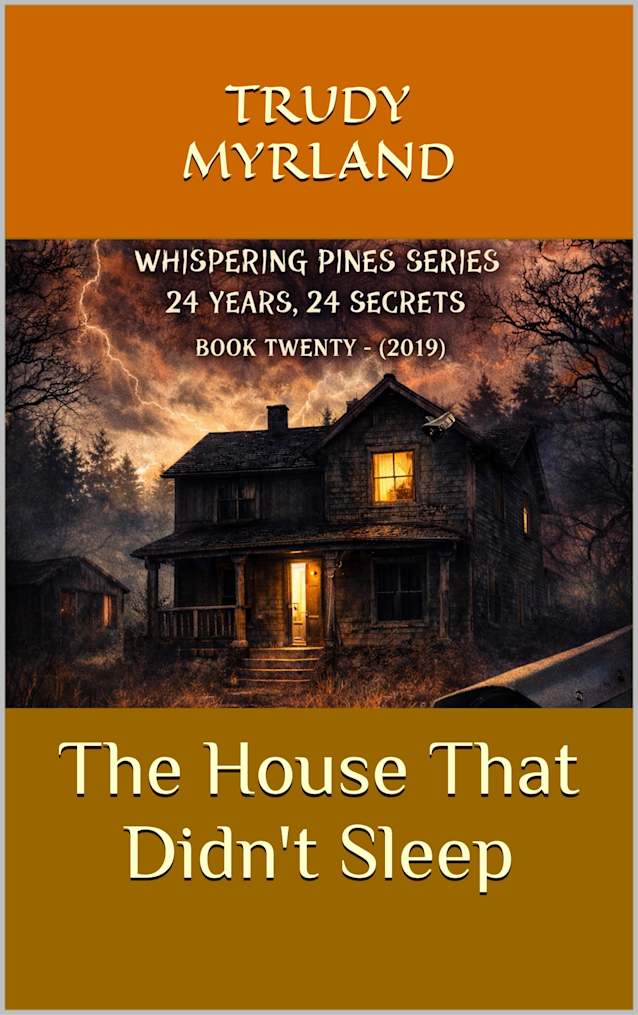
The House That Didn’t Sleep: BOOK TWENTY - (2019) (Whispering Pines 20)
About
Some houses creak.
Some houses settle.
This one watched.
When David Merrill buys a foreclosed house on the edge of Whispering Pines, he’s looking for quiet. The price is low, the paperwork clean, the past supposedly uncomplicated. It’s just an old place with thick walls, long hallways, and a view of the trees that feels almost peaceful.
At first, the disturbances are easy to dismiss.
- A light left on.
- A door not quite closed.
- Footprints that don’t make sense once you look too closely.
David tells himself it’s stress. New surroundings. An unfamiliar structure making ordinary sounds. Houses do that. People always say they do.
But the nights don’t stay ordinary.
The noises come in patterns. Rooms feel occupied when they’re empty. Objects move in ways that suggest intention, not accident. And the deeper David settles into the house, the more it becomes clear that whatever is wrong didn’t arrive with him.
It was already there.
As David begins documenting the disturbances, Whispering Pines responds the way it always has—to protect the quiet. Neighbors offer explanations that don’t quite hold. Records feel incomplete. The previous owner’s life seems to have ended abruptly, leaving behind unanswered questions and a structure that behaves like it remembers more than it should.
Then a body is discovered nearby.
The death is ruled separate. Unrelated. An unfortunate coincidence.
But houses don’t choose their occupants randomly.
And this one hasn’t been empty as long as everyone claims.
The House That Didn’t Sleep is a psychological horror thriller about isolation, surveillance, and the terror of realizing that safety is an illusion built on assumptions. This is not a story of jump scares or spectacle—it is a slow tightening of unease, where every unanswered question becomes part of the architecture.
Because some places don’t haunt you by what they do.
They haunt you by what they remember.
Why You’ll Love This Book
- • A slow-burn psychological horror that creeps instead of explodes
- • A grounded, realistic protagonist reacting the way real people do
- • A house that feels alive without ever being explained
- • Mounting dread built through patterns, repetition, and restraint
- • A fully resolved mystery that leaves lasting unease
- • A pivotal entry in a long-running series where the town can no longer look away
What to Expect Inside
- • Subtle environmental horror rooted in everyday life
- • A strong sense of place and isolation
- • Psychological tension over graphic content
- • A creeping realization that observation changes behavior
- • A town struggling to control what it no longer understands
This Book Is Perfect For Readers Who Enjoy
- • Stephen King–style atmospheric restraint
- • Psychological horror grounded in realism
- • Stories where houses feel like characters
- • Small-town thrillers with long memory
- • Horror that lingers after the final page
Each Whispering Pines novel stands alone.
Each year reveals a truth the town tried to forget.
The House That Didn’t Sleep marks the moment when private spaces stop being safe—and the town learns that what watches quietly can still do harm.
Lock the doors.
Turn off the lights.
The house is still awake.