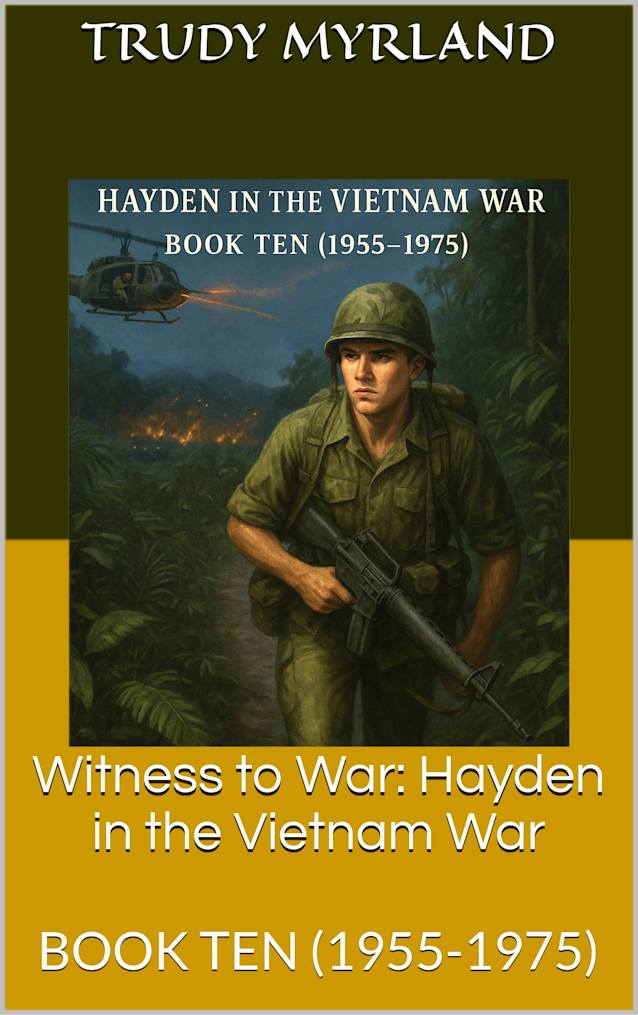
Witness to War: Hayden in the Vietnam War: BOOK TEN (1955-1975) (Witness to War – The Hayden Carter Chronicles 10)
About
The jungle does not forgive.
The rivers hide their secrets.
And for Hayden Carter, the Vietnam War is no longer history on a page — it is the fire he must walk through.
From the moment American “advisors” land in South Vietnam, Hayden finds himself among them, watching whispers turn into firefights. In the sweltering heat of the Mekong Delta, he learns that wars do not roar into being. They creep, slow and poisonous, until suddenly they consume everything.
By the early 1960s, Green Berets march through the jungle, helicopters thunder overhead, and Hayden sees how one president’s promise of “hope” can sink into shadows. He stands on the deck of a destroyer during the Gulf of Tonkin incident, watching a few shots ripple into full-scale war. In Vietnam, small sparks ignite infernos.
When the first waves of Marines storm ashore at Da Nang, Hayden is there. The ground trembles with artillery. Villages burn. The air itself seems alive with the thunder of Rolling Thunder — America’s attempt to bomb North Vietnam into submission. But the jungle does not break. The enemy does not bend. And Hayden learns that air power alone cannot crush resolve.
He flies with the Hueys into Ia Drang Valley, the first great clash of U.S. and North Vietnamese troops. Door guns chatter, soldiers leap into waist-high grass, and helicopters carry out more wounded than they brought in. Hayden sees courage and terror stitched into every flight. Victory here is measured not in ground gained, but in men brought back alive.
Then Tet shatters everything. In 1968, during the Vietnamese New Year, the cities erupt in fire. Saigon, Hue, even the U.S. Embassy itself comes under attack. Hayden watches as American soldiers fight block by block, house by house. The U.S. and South Vietnam win back the cities, but at home, the public sees only chaos. Hayden realizes that numbers on a map mean nothing if a nation has lost faith in its cause.
And far from the jungle, another war rages. Hayden marches with students in American streets, hears chants against the draft, sees police clash with protestors, and stands in horror at Kent State as gunfire drops four unarmed students. The battlefield is not just in Vietnam. It is in America’s own heart.
As Nixon promises “peace with honor,” Hayden watches the new word of the day: Vietnamization. U.S. troops leave. South Vietnam soldiers take their place. But Hayden sees the morale collapse, the hope drain, and the war spread like wildfire into Cambodia and Laos. Secret bombings rain down even as promises of peace fill the air.
Then comes My Lai — the darkest wound of all. Hayden sees the aftermath: unarmed villagers, women and children among the dead. It is a scar that cannot be explained away. In war, Hayden learns, sometimes the worst wounds are self-inflicted.
Peace talks drag on in Paris while men keep dying in rice paddies. Hayden hears diplomats argue over the shape of a table while soldiers bleed into the soil. Years pass, thousands die, and only in 1973 does the U.S. finally step away, leaving behind allies who still fight for survival.
And then, April 1975: the Fall of Saigon. Hayden stands on the rooftop of the U.S. Embassy, watching helicopters lift desperate people into the sky as North Vietnamese tanks crash through the gates. The war ends not with a treaty, not with a victory parade — but with chaos. With screams. With the thunder of rotors and the weight of betrayal.
Even then, the war is not finished. Hayden sees Vietnamese families fleeing on crowded boats, risking the sea for a chance at freedom. He learns that the echoes of war ripple long after the guns fall silent.
By the end, Hayden carries forward more than memories. He carries the truth: that Vietnam was not a war of clear answers, but of endless human cost. That courage and confusion can live side by side. And that the scars of one jungle can last for generations.